

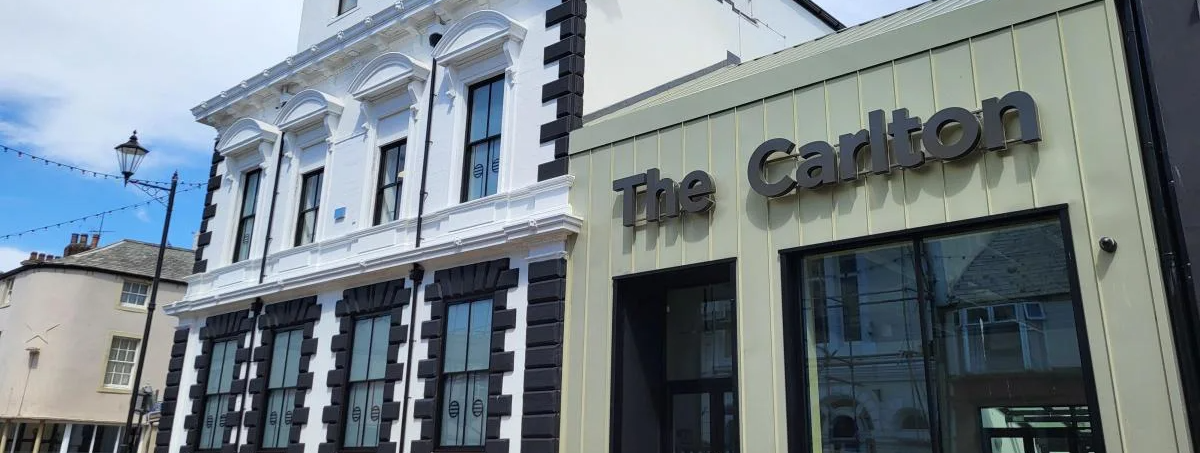
Cumberland Council has completed the redevelopment of The Carlton, a former cinema on Senhouse Street in Maryport, into a ground-floor entertainment and performance venue with first-floor office and workshop units, a project that matters to building and architecture professionals because it shows a nuclear industry operator's community fund now sitting alongside council and central government money as a routine third funding stream for town centre adaptive reuse. Consideration was disclosed as a £12 million scheme, funded by Cumberland Council, central government and a £400,000 contribution from Sellafield Ltd.
Cumberland Council is the local authority for Cumberland, England, delivering The Carlton as part of its wider Maryport town centre regeneration programme.
Sellafield Ltd is the nuclear site operator responsible for decommissioning the Sellafield site in Cumbria, funding this project through its Social Impact Multiplied (SIX) community investment programme.
Maryport Horizons Community Interest Company will manage the building on the council's behalf, letting seven first-floor office units of 11 to 26 sq m from £344 a month, with the venue opening to the public from September.
The structural driver is the growing normalisation of corporate community investment funds as a third funding stream in UK town centre regeneration, alongside council and central government money, with major industrial operators increasingly required to demonstrate local social value near their sites.
For the sector, the timing matters because The Carlton follows a wider pattern of cinema-to-mixed-use conversions in smaller UK towns, where councils increasingly favour flexible ground-floor cultural space paired with small business office units over single-use redevelopment, spreading redevelopment risk across two income streams rather than one.
Delegating day-to-day management to a Community Interest Company rather than retaining it in-house reflects a broader shift among councils toward third-sector operating models for regenerated civic assets, a structure that can widen the pool of organisations contractors and architects need to engage during design and fit-out.
The broader implication for the sector is that smaller market towns are increasingly able to assemble multi-source funding for adaptive reuse schemes without relying solely on Levelling Up-style national programmes, expanding the pipeline of modest but deliverable regeneration projects available to regional contractors.
Source: News and Star / Yahoo News UK






.png)