

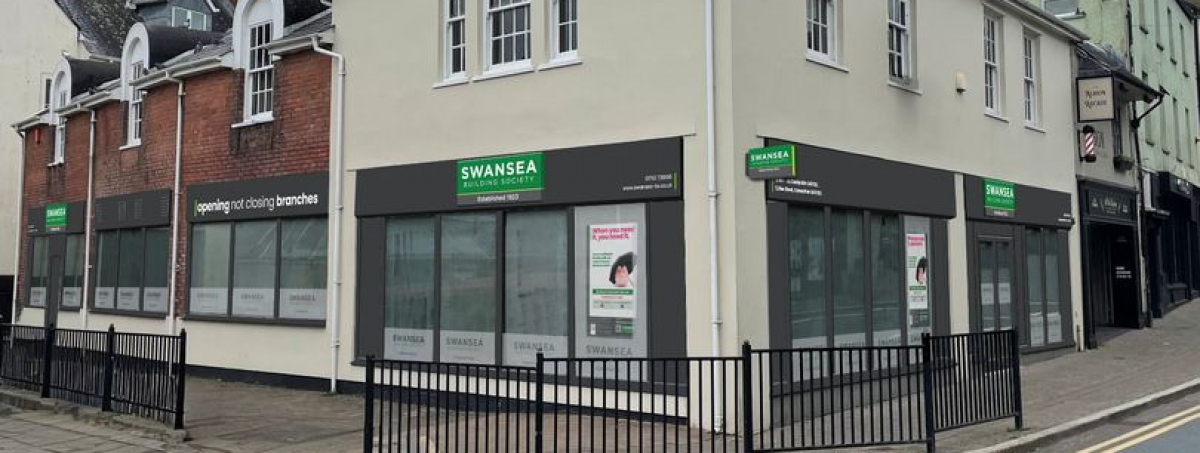
Swansea Building Society has purchased new premises on Blue Street, Carmarthen, relocating from rented offices on Lammas Street it has occupied since 2015, a move that matters to building and architecture professionals because it shows a growing regional mutual choosing freehold ownership and bespoke refurbishment over continued leasing as it expands. The Society confirmed the new premises measure approximately 4,284 sq ft.
Swansea Building Society is a Swansea-headquartered mutual founded in 1923, one of only three remaining mutual building societies in Wales and the only one headquartered in west Wales, with total assets of approximately £693.7 million in 2025.
The Blue Street building is being refurbished and redesigned to accommodate the Society's growing Carmarthen operation, which currently employs 15 people, with completion expected by the end of February 2027 and opening planned for early March.
The move follows the Society's 2022-23 expansion of its Swansea head office on Cradock Street, where it acquired and refurbished an adjoining property to accommodate workforce growth.
The structural driver is a wider Welsh town centre regeneration push, with Carmarthenshire County Council and the Welsh and UK governments funding schemes such as the Town Centre Vibrancy Fund and the transformation of the former Debenhams into the Atriwm public services hub, creating momentum for occupiers to commit capital to town centre premises rather than retreat to out-of-town sites.
For the sector, the timing matters because Swansea Building Society is choosing to buy and refurbish rather than continue renting, a pattern also seen in its 2022-23 Cradock Street expansion, suggesting financial institutions with growing branch networks increasingly prefer freehold control over their premises as they scale.
The purchase adds to a steady flow of small-scale commercial refurbishment work in Carmarthen town centre, where auction listings and vacant unit schemes show a market still working through post-pandemic churn even as anchor institutions like Swansea Building Society commit to long-term occupancy.
The broader implication for the sector is that regional mutuals and similar institutions, rather than national chains, are an underappreciated source of steady, smaller-scale refurbishment and fit-out work for architects and contractors serving Welsh market towns.
Source: The Intermediary / Wales247 / Carmarthenshire County Council






.png)